
The Frictionless Mind
On our semantic network's role in our cognitive fitness

We often mistake our thoughts as our own, but they are more like spectral projections of our history - echoes embedded in high-dimensional linguistic space and colored by the valence of emotions. Cognitive science suggests that our thoughts are outputs: emergent properties of neuronal activations attempting to minimize the error of predictions based on biased training data (Friston 2010). Precisely because our cognition is built on this fluid, probabilistic architecture, the mind is not a fortress of reason. It is a permeable membrane, constantly susceptible to rewiring by the environment it inhabits.
Probing the Latent Structure
Each experience, each interaction has the potential to shift the weights in our internal model of the world. This can happen consciously, if we are aware that we are learning. More often, however, this happens subconsciously. It’s when we slip into autopilot that the subconscious manifests - moments of irritation or anger, lapses in judgment, episodes of depression or anxiety. Observing individuals in the grips of such episodes, psychiatrists and psychologists attempted to devise methods for probing the subconscious to unearth what latent thoughts might be lurking beneath the surface, spurring these untoward behaviors. The most famous such instrument might be the Rorschach inkblot test. In asking the participant to verbally respond to an ambiguous visual stimulus, the Rorschach test attempts to probe the latent semantic structure connecting vision and language.
Free association is not relegated to psych wards. It appears frequently as a parlour trick - “say the first word that comes to mind” - and in our most beloved pastimes. Games like Pictionary and Charades operate on the same cognitive mechanism. In these games, success is defined by social alignment: if your visual-lexical associations match your partner’s closely enough, you win. Losing indicates there may be a mismatch between your semantic map and the maps of those you’re playing with.
Rewiring at Scale
Semantic alignment is no longer merely a parlor trick; it is a survival mechanism for the modern mind. Between Rorschach’s invention in 1921 and today, the requirement to update these maps has accelerated exponentially, driven singularly by technologies that propagate information. As noted by James Gleick in his chronicle of the information age, “We have witnessed the accumulation of a ‘flood’ of knowledge, where information is no longer a mere tool but the very environment in which we swim, fundamentally altering the cognitive landscape” (Gleick, 2011). From industrial engineering that augmented the reach of magazines and periodicals (Innis, 1951), to technologies that enabled digitization of information (Castells, 1996), each wave of innovation in information technology was met with a rewiring of humanity’s semantic networks.
Research into “transactive memory” demonstrates that as internet accessibility increases, human brains adapt by deprioritizing the retention of static facts in favor of remembering where to locate that information, effectively externalizing nodes of our semantic memory (Sparrow, Liu, & Wegner, 2011). Furthermore, the shift toward non-linear digital interfaces has been shown to alter the neural circuitry used for deep reading, promoting a “skimming” style of semantic processing that prioritizes rapid pattern recognition over sustained, syntactic analysis (Wolf, 2007). Finally, this exposure to abstract, information-dense environments has driven a massive shift in cognitive classification styles, moving humanity from concrete, utilitarian associations (e.g., grouping dogs with rabbits because both are used for farming) to abstract, scientific taxonomies (e.g., grouping dogs with rabbits because both are mammals) (Flynn, 2007).
The Elimination of Friction
Yet, if the internet era transformed us into “skimmers” efficiently filtering vast databases, the Generative AI era threatens to transform us into something far more passive. The fundamental shift is not just the volume of information, but the elimination of cognitive friction. Unlike the book or the search engine, which imposed a “friction of retrieval” that allowed time for analytical pause, the fluid, conversational nature of LLMs collapses the distance between query and response. This rapid-fire feedback loop and pre-masticated output bypasses the deliberate, inhibitory circuits of “System 2” thinking, defaulting instead to “System 1”: the fast, automatic, and emotional processing that runs entirely on pre-existing associations (Kahneman, 2011). Consequently, the risk is not that AI replaces or erodes our intelligence, but that its immediacy confines us to the reactive firing of our current semantic networks, preventing the slow, deliberate friction required to wire new ones.
Spreading Activation
This phenomenon rests on a cognitive mechanic known as spreading activation, the process by which the brain retrieves information from a semantic network. As established in seminal memory research, when a concept is stimulated (e.g., “Fire”), activation radiates instantly to the nearest associated nodes (e.g., “Heat,” “Red,” “Smoke”) based on link strength, fading as it travels further afield (Collins & Loftus, 1975).
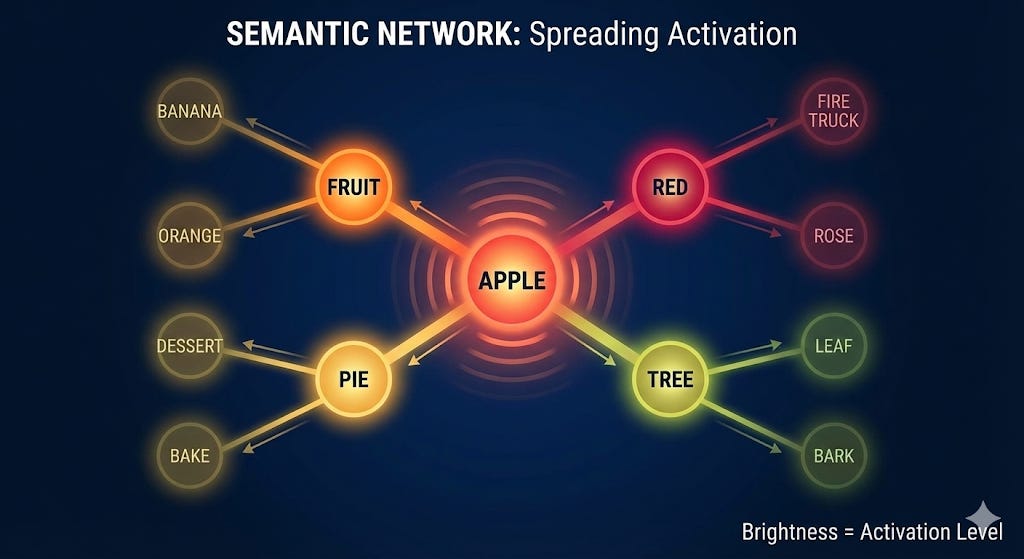
In a rapid-fire prompt-response interactions with Generative AI, we rely heavily on this automatic ripple effect to parse the machine’s output. Because Large Language Models are themselves probabilistic engines designed to predict the most likely next token, they frequently output text that mirrors the path of least resistance in our own minds. The danger, therefore, is one of “cognitive ease”: the AI presents us with a sequence of ideas that fits our pre-activated expectations so perfectly that we bypass the critical evaluation required to detect subtle errors or hallucinations (Kahneman, 2011). We are not just thinking fast; we are surfing the shallowest grooves of our existing semantic maps, reinforcing old connections rather than forging the difficult, non-obvious links that characterize deep learning.
Experts and Novices
Rebecca Wicker recently wrote, “Many people struggle with prompting because they struggle with structured thinking and clear writing generally.” This week, Jenny Boavista wrote that LLMs might strengthen us cognitively by “accelerat[ing] pattern recognition by surfacing connections across large information sets that would otherwise be inaccessible” and “enabl[ing] rapid iteration, which can strengthen judgment when humans remain responsible for evaluation and decision-making.”
Structured thinking rests on top of pattern recognition, which is, in turn, predicated on having a rich bank of patterns. Studies of expert reasoning have shown that experts are able to sift through noise - distractions, false alarms - because of the depth of their pattern bank: they’ve personally solved hundreds of similar problems before, which allows them to fit the current scenario into the semantic map they’ve developed. This specific cognitive architecture is well-documented in the work of Vimla Patel, whose studies on medical decision-making reveal that experts utilize “forward reasoning”—moving efficiently from observations to a solution—because their semantic networks are sufficiently organized to trigger the correct diagnostic schemas automatically (Patel & Groen, 1986). In contrast, novices lack this dense network and are forced into “backward reasoning,” a slower, error-prone process of hypothesizing and fact-checking. Furthermore, this aligns with the “chunking” theory established by Chase and Simon (1973), which demonstrated that experts do not possess superior raw memory, but rather a superior ability to group complex information into single, retrievable semantic units based on prior experience. Of course, experts in one domain will invariably be novices in another. The key to mitigating bias is metacognitive awareness of the mode of reasoning one is engaging to ensure it is relevant for the problem at hand.
However, when we engage in rapid-fire reasoning within domains where our semantic networks are thin, we risk short-circuiting the opportunity for metacognitive pause, which also comes from experience. Recent research into “truth discernment” suggests that in the absence of a deep reservoir of stored knowledge, the brain substitutes validity with fluency—the ease with which information is processed. According to the “fluency heuristic” described by cognitive psychologists like Lisa Fazio and Elizabeth Marsh, if a statement feels familiar or linguistically smooth, a novice brain will default to accepting it as true, effectively bypassing the semantic verification that an expert would automatically trigger (Fazio, Brashier, Payne, & Marsh, 2015). This makes the “thin-networked” mind uniquely susceptible to red herrings and “illusory truth effects,” where mere repetition of false information increases belief in it (Pennycook, Cannon, & Rand, 2018). While an expert’s eye-tracking data reveals they can immediately distinguish relevant signals from irrelevant noise (Sheridan & Reingold, 2014), a novice lacks this structural map, leaving them to treat legitimate data and hallucinations with equal cognitive weight. Thus, the novice is not just “uninformed”; they are functionally defenseless against the friction-free confidence of generative AI.
From Challenge to Fitness
If our semantic associations underlie our expertise, then perhaps by probing them - even challenging them - we can develop a measure of our cognitive fitness: how semantically capable are we of standing up to a prompt? Or how susceptible are we to being swayed by false facts delivered fast?
Science tries to avoid being normative: it has refrained from cataloguing which semantic architectures are beneficial or harmful, which thought associations are healthy or unhealthy. Yet, if our semantic networks underlie our success in co-existing with AI, then I believe that we need to approach semantic networks normatively. The rapid pervasion of LLMs into our lives raises this to a matter of cognitive epidemiology: just as there are certain states of physiological fitness that reduce susceptibility to diseases of lifestyle, there are, I hypothesize, certain states of cognitive fitness that reduce our susceptibility to algorithmic misinformation and AI psychosis. Defining these protective architectures is the urgent frontier of modern cognitive science. Unless we learn to measure and cultivate this specific form of “cognitive fitness,” we risk becoming not the orchestrators of our new tools, but the instruments of their distortions.
Disclaimer
As an empirical caveat, note that semantic associations represent only one facet of cognition. They reveal certain types of patterns in our memory, particularly those that have linguistic embedding. A measure of your semantic associations must be interpreted in the context of the broader cognitive architecture: your fluid reasoning, your working memory capacity, and your processing speed. These are the fundamental faculties that underlie how we interact with an LLM, determining not just what we know, but how effectively we can manipulate that knowledge under pressure (Deary, Penke, & Johnson, 2010).
References
Castells, M. (1996). The rise of the network society. Blackwell.
Chase, W. G., & Simon, H. A. (1973). Perception in chess. Cognitive Psychology, 4(1), 55–81. https://doi.org/10.1016/0010-0285(73)90004-2
Collins, A. M., & Loftus, E. F. (1975). A spreading-activation theory of semantic processing. Psychological Review, 82(6), 407–428. https://doi.org/10.1037/0033-295X.82.6.407
Deary, I. J., Penke, L., & Johnson, W. (2010). The neuroscience of human intelligence differences. Nature Reviews Neuroscience, 11(3), 201–211. https://doi.org/10.1038/nrn2793
Fazio, L. K., Brashier, N. M., Payne, B. K., & Marsh, E. J. (2015). Knowledge does not protect against illusory truth. Journal of Experimental Psychology: General, 144(5), 993–1002. https://doi.org/10.1037/xge0000098
Flynn, J. R. (2007). What is intelligence?: Beyond the Flynn effect. Cambridge University Press.
Friston, K. (2010). “The free-energy principle: a unified brain theory?” Nature Reviews Neuroscience, 11(2), 127–138.
Gleick, J. (2011). The information: A history, a theory, a flood. Pantheon.
Innis, H. A. (1951). The bias of communication. University of Toronto Press.
Kahneman, D. (2011). Thinking, fast and slow. Farrar, Straus and Giroux.
Patel, V. L., & Groen, G. J. (1986). Knowledge based solution strategies in medical reasoning. Cognitive Science, 10(1), 91–116. https://doi.org/10.1016/S0364-0213(86)80010-6
Pennycook, G., Cannon, T. D., & Rand, D. G. (2018). Prior exposure increases perceived accuracy of fake news. Journal of Experimental Psychology: General, 147(12), 1865–1880. https://doi.org/10.1037/xge0000465
Sheridan, H., & Reingold, E. M. (2014). Expert vs. novice differences in the detection of relevant information during a chess game: Evidence from eye movements. Frontiers in Psychology, 5, Article 941. https://doi.org/10.3389/fpsyg.2014.00941
Sparrow, B., Liu, J., & Wegner, D. M. (2011). Google effects on memory: Cognitive consequences of having information at our fingertips. Science, 333(6043), 776–778. https://doi.org/10.1126/science.1207745
Wolf, M. (2007). Proust and the squid: The story and science of the reading brain. HarperCollins.
What’s strong here is the way it reframes AI risk away from intelligence replacement and toward friction removal, where ease, fluency, and rapid alignment quietly lock cognition into its existing grooves. By grounding the argument in semantic networks, spreading activation, and expert–novice asymmetries, it makes clear why LLMs amplify bias differently depending on the depth of a person’s internal structure. The notion of “cognitive fitness” as a protective architecture feels like the real contribution, especially as a way to think normatively without collapsing into hype or moral panic.
I like your phrasing here, “cognitive ease” and excellent job reinforcing what happens to the brain when we don’t have friction; swimming in an endless pool of shallow old connections, unable to build new.